Most general contractors know the Ontario Building Code governs their projects. Fewer know exactly what it says about welded connections — and that gap creates real liability.
If you are overseeing a project with structural steel, load-bearing framing, or any welded assembly that forms part of the building structure, here is what you actually need to understand about code compliance before work starts.
The OBC Does Not Write Its Own Welding Rules
The Ontario Building Code does not define welding procedures itself. Instead, it adopts established industry standards by reference. For structural steel fabrication and erection in Ontario, the governing document is CSA W59: Welded Steel Construction.
That standard covers qualification of welders and welding procedures, acceptable weld types for specific connection designs, inspection requirements and acceptance criteria, and pre-heat and inter-pass temperature controls for different steel grades.
When the OBC says a structure must be built to "good engineering practice," CSA W59 is the benchmark an inspector or engineer will use to evaluate whether your welds meet it.
Welding Qualifications: What the Code Expects
CSA W59 distinguishes between a certified welder and a qualified welder. This distinction matters on site.
A certified welder has passed third-party testing through an accredited body — typically the Canadian Welding Bureau (CWB). Their certification covers specific weld processes, positions, and material thicknesses.
A welder can also be qualified in-house by a fabricator or contractor through a supervised procedure qualification test. This is permitted under the standard, but the test records must be documented and available for review.
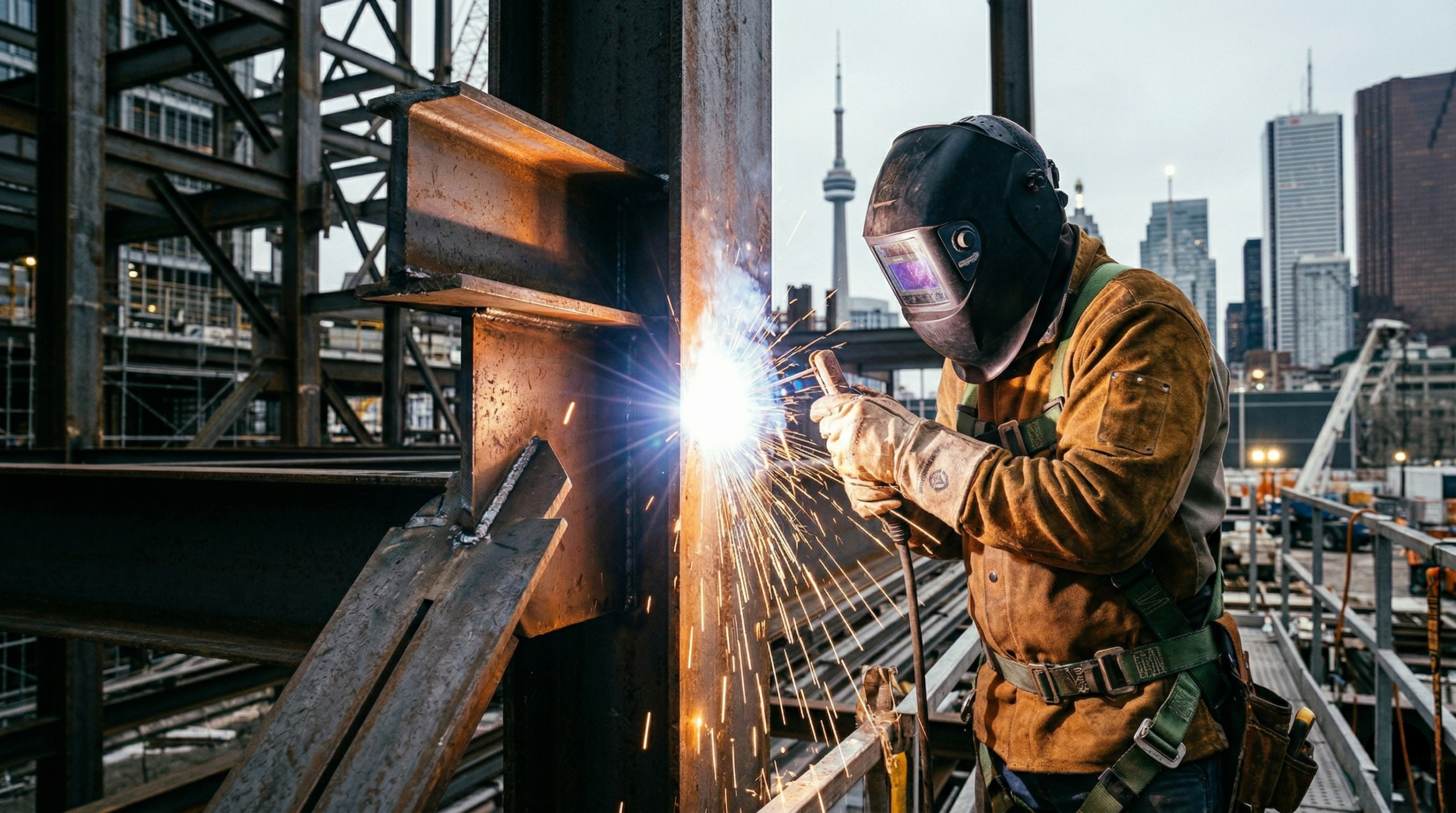
For structural work — including load-bearing connections, column base plates, moment connections, and beam-to-column welds — you need welders who are qualified for the specific joint type and position required by the drawings. Not just someone who "knows how to weld." Our structural steel welding service deploys CWB-certified welders with documented qualifications for every connection type.
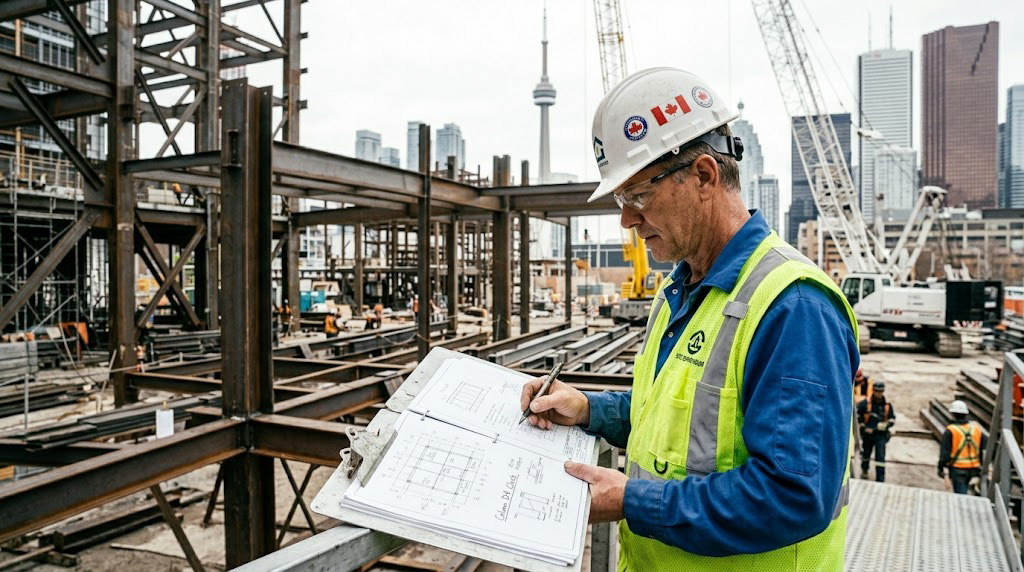
Before Structural Welding Begins, Ask For:
- Welder qualification records (process, position, material)
- Weld Procedure Specification (WPS) for each joint type
- Procedure Qualification Record (PQR) backing each WPS
If your sub cannot produce these, stop the work. Getting them after the fact is much harder than requiring them upfront.
What Needs to Be Welded vs. What Can Be Bolted
Engineers specify welded vs. bolted connections based on load type, joint geometry, and code requirements. As a GC or site super, you are not making that call — but you need to know when a change has been made without authorization.
Substituting a bolted connection for a welded one, or vice versa, without an engineer's approval is a structural change. It requires a revised drawing and, depending on the project, may trigger a building permit amendment.
This comes up most often in steel stud framing tie-downs and hold-downs, beam-to-column connections on mixed-material structures, ledger angles and shelf plates in masonry-backup wall systems, and custom stair stringers and guard post bases.
If a welder on site tells you "we always do it this way," that is not a substitute for an engineer's stamp. Flag it, document it, and get written confirmation before proceeding.
Inspection: Who Does It and When
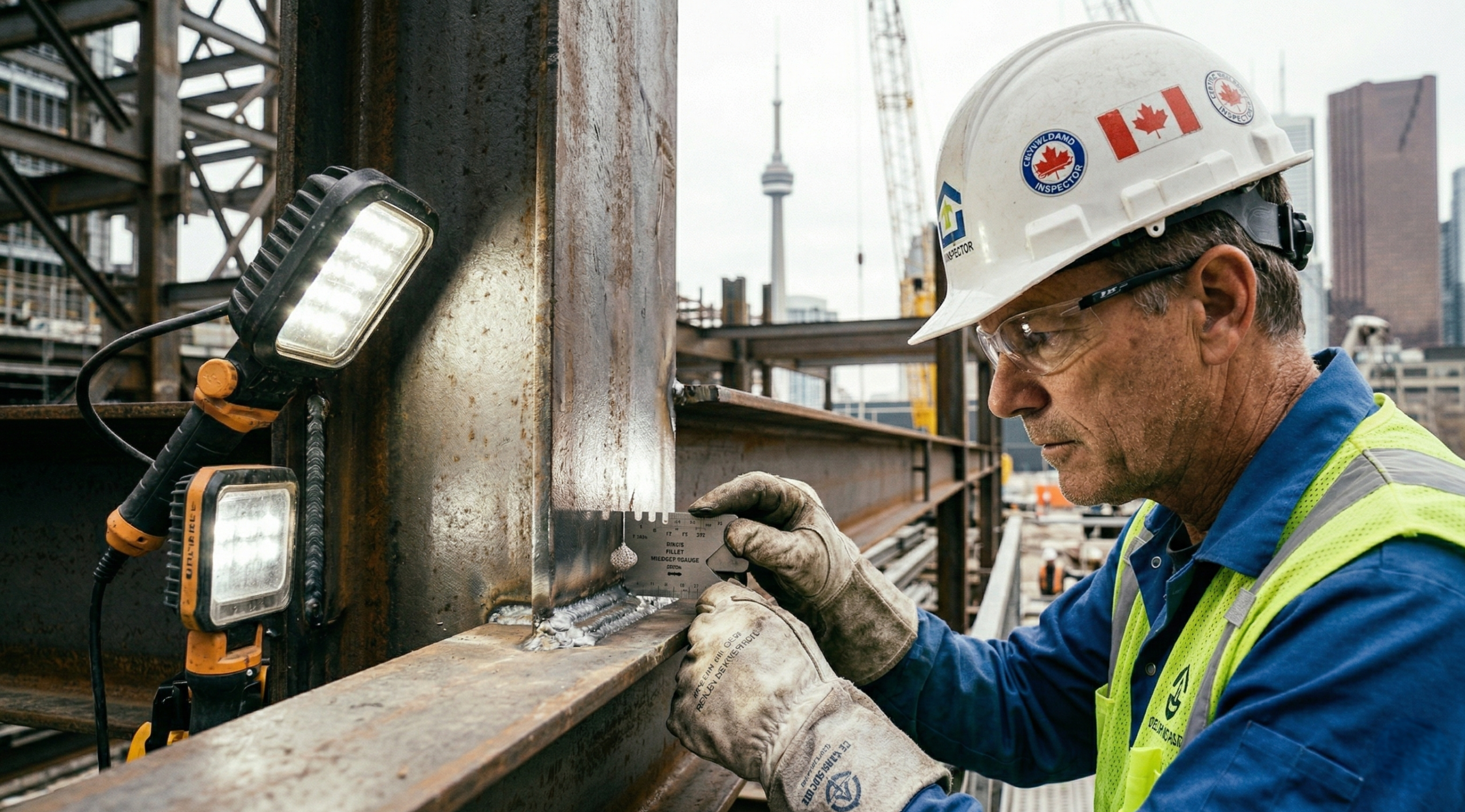
Under the OBC, certain structural work requires inspection by a qualified person — typically a professional engineer or a certified welding inspector (CWI) acting under engineering oversight.
General inspections by a building inspector do not substitute for structural weld inspection. A municipal inspector checking your framing is not qualified to evaluate weld quality to CSA W59 criteria. That is a separate scope.
For projects where welded connections are part of the primary load path, expect visual weld inspection on all accessible connections, non-destructive testing (NDT) — typically ultrasonic or magnetic particle — on critical joints if specified by the engineer, and documentation of all rejected welds and repairs.
Repairs to rejected welds must follow a documented repair procedure and be re-inspected. "Grinding it smooth" is not a repair.
Where Most Sites Get Exposed
In practice, OBC compliance failures on welded connections tend to cluster around a few specific situations:
Common Exposure Points:
Unqualified welding subcontractors. The lowest bid sometimes comes from someone without documented welder qualification. If something fails and you are the GC of record, you share the exposure.
Field changes without documentation. A connection gets modified on site to work around a coordination issue. No revised drawing is produced. The change never gets reviewed.
Missing inspection at the right stage. Inspection is scheduled too late, connections are already covered, and the project has to move forward on assumption.
Repairs without re-inspection. A rejected weld gets "fixed" and assumed to be resolved without a re-inspection and sign-off.
None of these are hard problems to prevent. They are process failures, not technical ones.
The Bottom Line for GCs and Site Supervisors
The Ontario Building Code sets the minimum standard. CSA W59 defines how welded connections must be executed and verified to meet it. Your responsibility as the GC is to make sure your structural welding subcontractors are qualified, their procedures are documented, and inspection happens at the right time.
That is not just about passing inspection. It is about making sure the building performs as designed — and that liability does not come back to you when it does not.
Structural Welding That Meets OBC and CSA W59 Standards
CanaWelding Inc. is a division of Canadian Structures — CanaStruct Inc., a company that has held an HCRA license since its founding. Our welders work to CSA W59 standards on every structural project. We provide full documentation on welder qualifications and weld procedures before work starts.
Serving Toronto, Mississauga, Brampton, Vaughan, Markham, and the entire GTA.
Call (647) 641-0550 Email Weld@Canawelding.caHCRA-licensed · About CanaWelding · All Services · Request a Quote
Frequently Asked Questions
Does the Ontario Building Code specify welding procedures?
The OBC does not define welding procedures directly. It adopts CSA W59 (Welded Steel Construction) by reference as the governing standard for structural steel welding in Ontario. CSA W59 covers welder qualification, procedure qualification, acceptable weld types, and inspection requirements.
Do welders need to be CWB certified for structural work in Ontario?
CWB certification is the most common path, but CSA W59 also permits in-house qualification through a supervised procedure qualification test. Either way, the welder must be qualified for the specific process, position, and material thickness required by the structural drawings. Documentation must be available on site.
Can a bolted connection be substituted for a welded connection without approval?
No. Substituting a bolted connection for a welded one, or vice versa, without the structural engineer's written approval is a structural change. It requires a revised drawing and may trigger a building permit amendment depending on the project scope.
Who inspects structural welds on an Ontario construction project?
Structural weld inspection must be performed by a qualified person — typically a professional engineer or a certified welding inspector (CWI) working under engineering oversight. A general municipal building inspector is not qualified to evaluate weld quality to CSA W59 criteria.