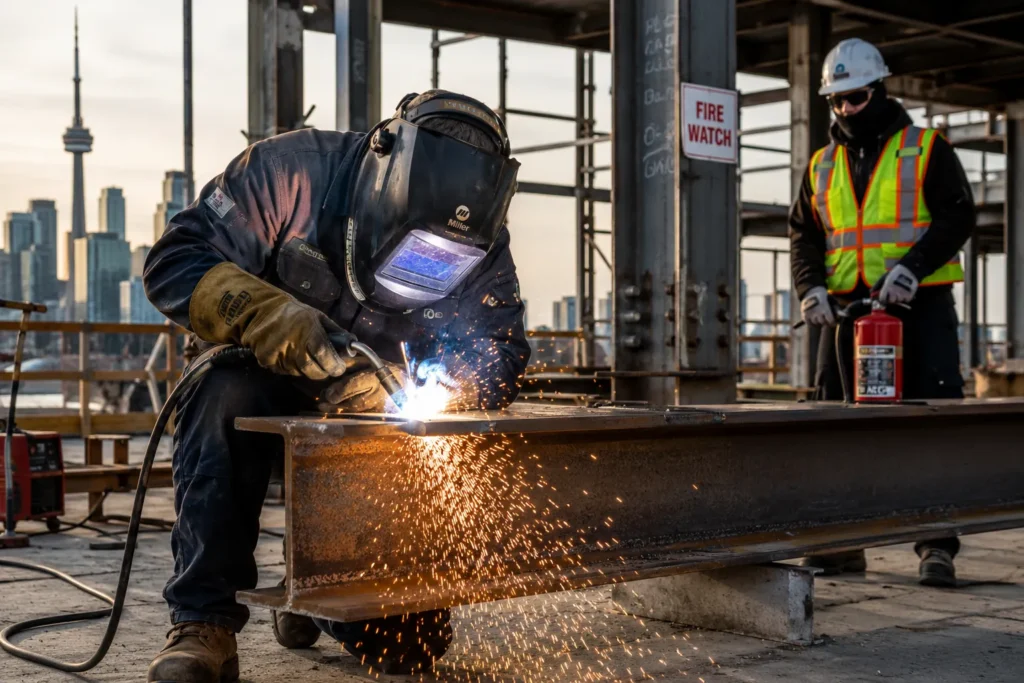
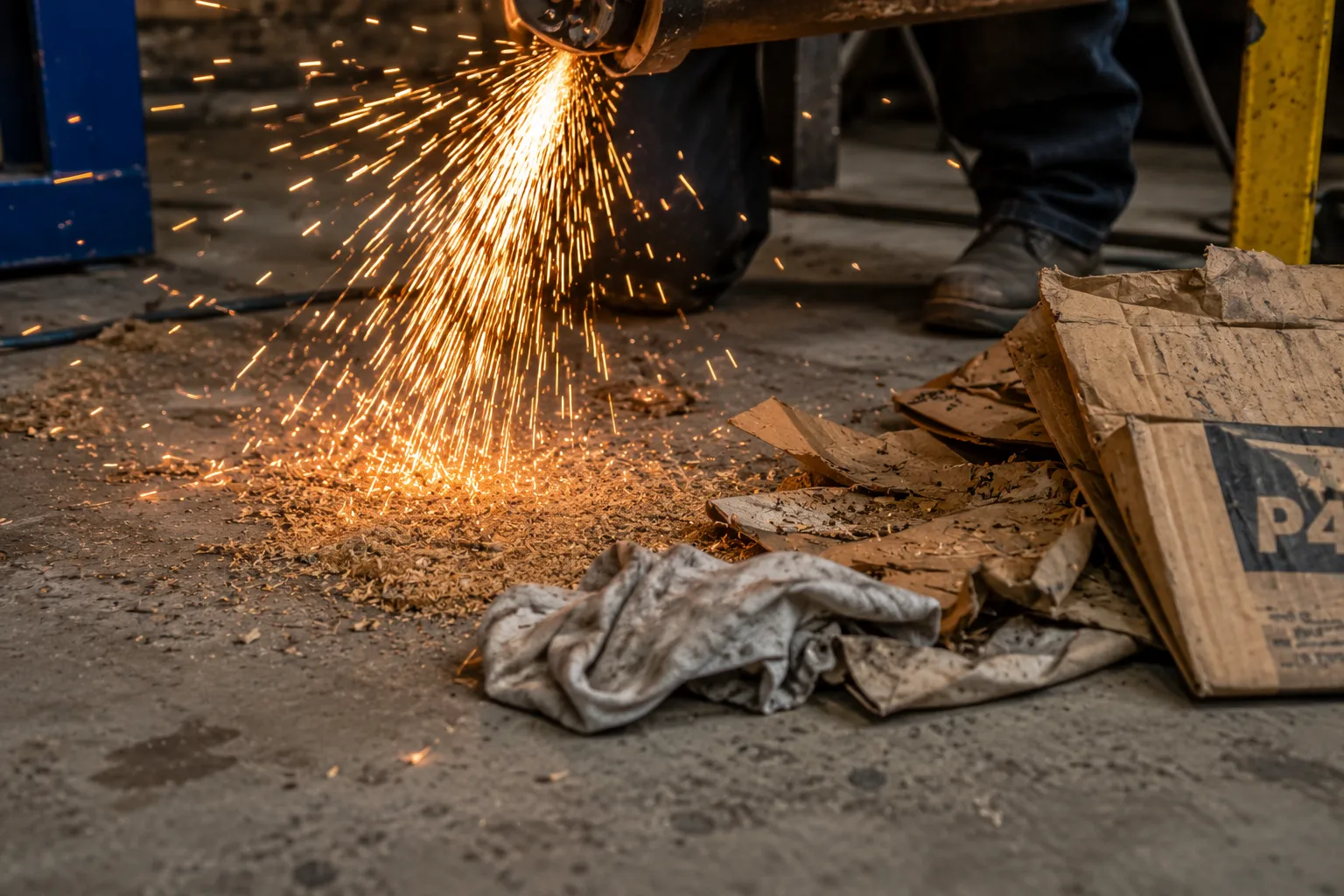
Every year, a surprising number of structure fires trace back to the same root cause: a welding, cutting, or grinding job that started without anyone stopping to check what was sitting nearby. A stray spark lands on sawdust, insulation, or a grease-soaked rag, and a five-minute repair turns into a five-alarm fire. The tool that exists specifically to prevent this chain of events is the hot work permit.
If you manage a construction site, a warehouse, a manufacturing floor, or a property with active renovation work in Toronto and the GTA, understanding hot work permits isn't optional paperwork. It's a legal requirement under Ontario law, an insurance condition, and one of the simplest ways to keep a job site from becoming an incident report. This guide covers what hot work is, why permits exist, the regulations and standards behind them, who is responsible for what, and the full step-by-step process for doing it right.
What Counts as “Hot Work”?
Hot work is any task that can produce flame, sparks, or enough heat to ignite nearby materials. According to the Canadian Centre for Occupational Health and Safety (CCOHS), the government agency responsible for national workplace safety guidance, hot work includes:
- MIG, TIG, and stick (arc) welding
- Oxy-fuel and plasma cutting
- Brazing and soldering
- Grinding and other spark-producing metalwork
- Torch-applied roofing and any open-flame trade work
The common thread is an ignition source working in proximity to combustible or flammable material. CCOHS notes that a large share of hot work fires happen during “quick five-minute” jobs performed in areas that were never intended for welding or cutting, precisely because nobody treated the task as hot work in the first place.
Why Hot Work Permits Exist?
A hot work permit is a written authorization confirming that a qualified person has assessed the work area, identified the hazards, and put controls in place before any torch or welder is switched on. It isn't a formality. It forces four things to happen before ignition:
- Someone with authority actually inspects the area for combustibles, flammable vapours, and structural risk.
- Everyone on site knows hot work is happening, where, and for how long.
- Fire protection (extinguishers, hoses, fire watch personnel) is confirmed in place before work starts.
- There's a documented record of who authorized the work, in case something does go wrong.
CCOHS frames this as part of a broader “hot work management program,” which also covers where and when hot work is allowed, who can authorize and perform it, and how workers are trained for their specific role in the process.
The Legal and Regulatory Framework in Ontario
Hot work isn't governed by a single rulebook. In Ontario, several overlapping laws and standards apply, and a compliant job satisfies all of them at once.
- The Occupational Health and Safety Act (OHSA): Under OHSA, employers must take every reasonable precaution to protect workers. For hot work specifically, Regulation 851 (Industrial Establishments) addresses safe handling of hazardous materials and required ventilation, while Regulation 632/05 governs hot work carried out inside confined spaces.
- The Ontario Fire Code: Ontario Regulation 213/07, made under the Fire Protection and Prevention Act, sets out fire prevention requirements for welding and cutting operations, including keeping combustible and flammable materials clear of the work area or protecting them with noncombustible shielding when they can't be moved.
- CSA W117.2: The CSA Group standard Safety in Welding, Cutting, and Allied Processes is the Canadian technical standard behind most hot work programs nationwide. It sets out requirements for protective equipment, ventilation, fire prevention, and safe practice specific to welding and cutting work.
- NFPA 51B: The American National Fire Protection Association standard, Fire Prevention During Welding, Cutting, and Other Hot Work, is widely referenced across Canadian industry as the operational basis for hot work permit systems, fire watch duration, and site preparation, even where it isn't directly adopted into provincial law.
- WSIB coverage: The Workplace Safety and Insurance Board doesn't issue hot work permits, but insurance coverage and claims outcomes assume a compliant safety program was in place. A contractor who can't produce a hot work permit after an incident is in a materially worse position with WSIB and with their own liability insurer.
Together, these four sources are why a hot work permit on a Toronto job site typically references CWB welding standards, CSA safety requirements, and Ontario Fire Code clearances all on the same page.
Who Needs a Hot Work Permit?
Hot work permits generally apply to any welding, cutting, brazing, or grinding performed outside of a fixed, designated welding area (a shop bay built for the purpose, with noncombustible walls and floors and no stored combustibles). That covers most of what makes mobile welding necessary in the first place:
- Active construction sites, where structural steel is being modified or reinforced mid-build
- Warehouses, manufacturing floors, and logistics yards with materials, fuel, or packaging present
- Occupied commercial and residential buildings undergoing renovation
- Confined spaces such as tanks, vaults, or shipping containers
- Any site where a general contractor, property manager, or building owner has their own permit-to-work system in place
If you're bringing in a mobile welder for on-site structural steel work on an active build, or for an emergency repair after hours, the hot work permit process applies just as much as it would in a fixed shop, arguably more, since the environment wasn't purpose-built for welding in the first place.
What's Included in a Hot Work Permit
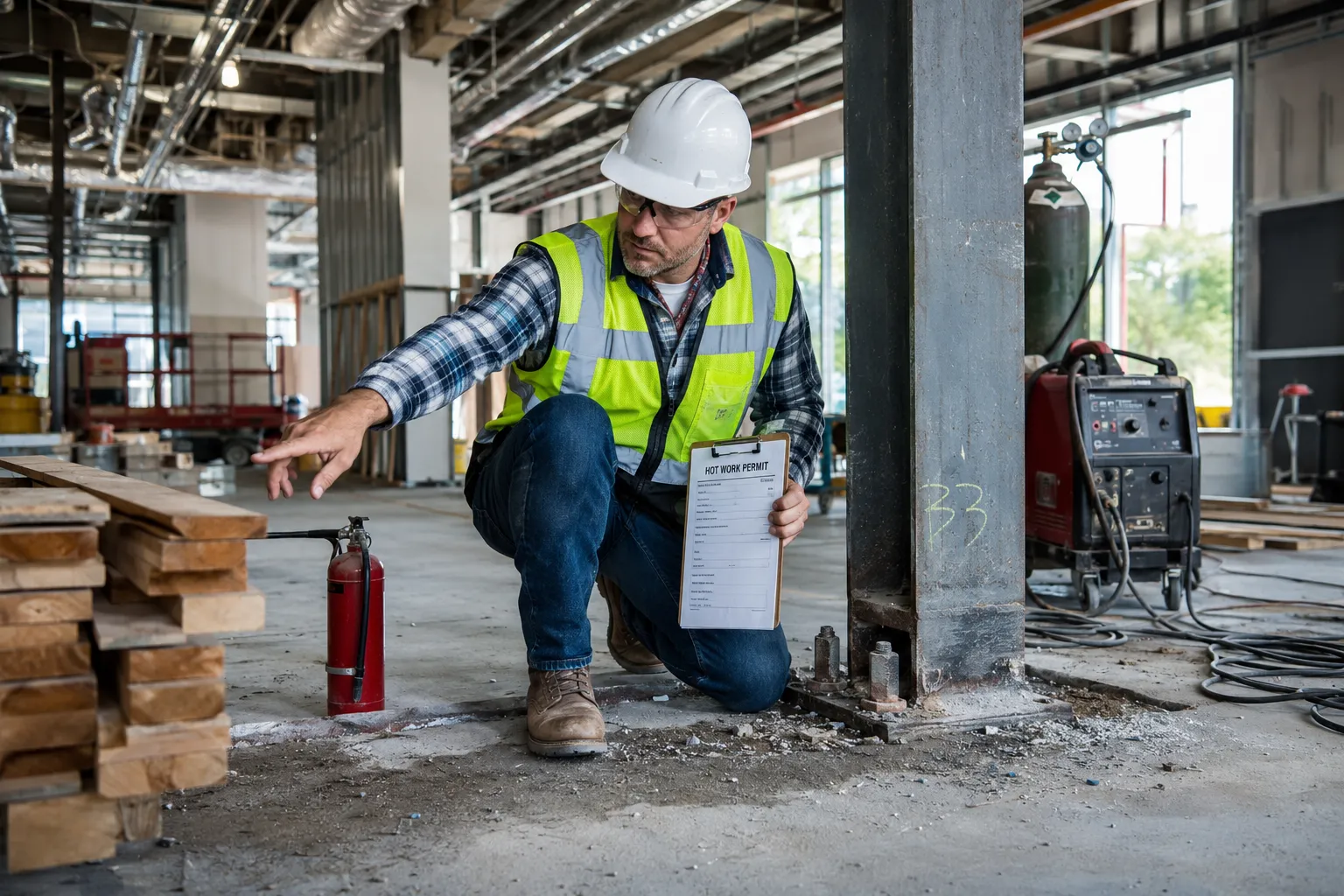
A properly filled-out hot work permit is short, but it isn't vague. At minimum, it documents:
- Location and description of the work exactly where the hot work is happening and what process is being used (MIG, TIG, stick, torch cutting, grinding)
- Date and time window permits are typically valid for a single shift, not open-ended
- Names and signatures, the person authorizing the work, the person performing it, and the assigned fire watch
- Fire hazard assessment, what combustibles are present, how far they are from the work, and how they've been protected or removed
- Fire protection equipment: confirmed on site, extinguisher type and location, hose access, sprinkler status
- Atmospheric testing results, where applicable, required for confined spaces or areas with potential flammable vapour buildup
- Fire watch duration after work stops, signed off once the post-work monitoring period is complete
The Hot Work Permit Process, Step by Step
1. Assess whether hot work can be avoided
Before a permit is even issued, CCOHS recommends checking whether the job can be done a safer way. Their hot work fact sheet gives several substitution examples:
| Instead of | Consider |
|---|---|
| Torch or saw cutting | Manual hydraulic shears |
| Welding a connection | Mechanical bolting |
| Sweat soldering | Screwed or flanged pipe |
| Torch or radial saw cutting on pipe | Mechanical pipe cutter |
This isn't always practical, structural steel connections in particular usually do require welding to meet code, but it's worth ruling out before authorizing an ignition source in a hazardous area.
2. Prepare and clear the work area
If hot work is going ahead, the area needs to be cleared of combustible and flammable material, or that material needs to be protected. The Ontario Fire Code and CCOHS both point to the same benchmark: combustibles should be moved at least 11 metres (roughly 35 feet) from the work zone, or shielded with fire-resistant blankets, sheet metal, or other noncombustible barriers if they can't be moved. Floors are swept of debris, ducts and floor openings are sealed or covered, and any spilled grease or oil is cleaned up.
3. Test the atmosphere in confined or enclosed spaces
Inside tanks, vaults, shipping containers, or other enclosed spaces, oxygen levels, flammable gas concentration, and airborne contaminants need to be tested before work starts and monitored throughout. This is a specific requirement under Ontario Regulation 632/05 for confined space entry, and it's non-negotiable when hot work is involved.
4. Stage fire protection equipment
An appropriate fire extinguisher (typically ABC-rated) needs to be within reach before the first spark flies, along with any additional suppression equipment the site calls for. Sprinkler systems and hose stations in the area should be confirmed operational, not assumed to be.
5. Assign and brief a fire watch
A trained fire watch is stationed in the work area for the entire duration of hot work, including breaks, and remains after work stops. This person's only job is watching for smouldering material, sparks that travelled further than expected, or heat building up in adjacent spaces, including the floor below and the space above the work.
6. Perform the work under the permit's conditions
Welders wear the personal protective equipment specified for the process and environment, and the work stays within the scope, location, and time window the permit describes. If conditions change (a new fire hazard appears, ventilation stops working, the confined-space atmosphere shifts) work stops until the permit is reassessed.
7. Maintain the fire watch after work ends
This is the step most often shortened or skipped, and it's the one most likely to matter. Standards differ slightly on the minimum duration:
- OSHA (U.S.) sets a 30-minute minimum fire watch after hot work ends.
- NFPA 51B and current CCOHS guidance call for at least 60 minutes, with the watch extended to three hours or more in higher-risk conditions, such as work performed inside a storage area with combustibles present.
The fire watch checks not just the immediate work area but adjacent spaces sparks or heat could have reached, including through wall or floor openings. Only once that monitoring period has passed without incident is the hot work permit closed out.
8. Close out and file the permit
The completed permit, signed off by the fire watch and the authorizing person, gets filed as part of the site's safety records. If an insurer, WSIB, or the Ontario Fire Marshal's office ever asks for proof that a specific job was properly authorized and supervised, this is the document that answers the question.
Roles and Responsibilities
A hot work permit system only works if everyone involved understands their specific role:
The permit-issuing authority (often a site supervisor, safety officer, or property manager) inspects the area, confirms controls are in place, and signs the permit before work begins. This person has the authority to refuse or halt hot work if conditions aren't safe.
The person performing the hot work (the welder or contractor) follows the permit's conditions exactly, uses proper PPE, and stops work immediately if the situation changes.
The fire watch is a dedicated, trained person whose only responsibility during the work is monitoring for fire hazards, not assisting with the weld itself. They need firefighting equipment within reach and the authority to call a halt to work if something looks wrong.
Contractors and subcontractors, including mobile welders brought onto someone else's site, are responsible for following the host site's hot work permit process in addition to their own company's safety procedures. This is one of the reasons CWB-certified welders working on active GTA construction sites coordinate directly with the general contractor's safety officer before any torch is lit.
What Happens If You Skip It
Beyond the obvious fire risk, working without a required hot work permit exposes a business to real regulatory and financial consequences. OHSA violations in Ontario carry some of the steepest workplace safety penalties in the country, and corporations can face fines running into the millions for serious violations. An uncontrolled hot work fire can also void insurance coverage if the policy required a documented permit system, and it puts WSIB claims (and the injured worker's outcome) in a much more complicated position. For a general contractor or property manager, a missing hot work permit after an incident isn't a paperwork gap, it's a liability problem.
Hot Work on Active GTA Construction Sites
This is where hot work permits come up most often for CanaWelding's clients. Structural steel modifications on an active build, whether it's a beam adjustment mid-framing or a last-minute design change, almost always happen in an environment full of the exact materials a hot work permit is designed to protect: framing lumber, insulation, packaging, fuel for other equipment, and workers moving through the same space.
Our on-site welding and structural steel welding teams work inside general contractors' hot work permit systems as a matter of course, coordinating with site safety officers, confirming fire watch coverage, and completing work to CWB W47.1 standards before signing off. For after-hours or urgent repairs, our emergency welding service follows the same process under compressed timelines, because a rushed job is exactly when hot work fires happen.
Hot Work Permit Checklist
A quick reference for site supervisors and contractors before any welding, cutting, or grinding begins:
- Confirm hot work can't reasonably be avoided (mechanical alternative isn't practical)
- Inspect the work area and identify all combustible and flammable materials
- Clear combustibles at least 11 m (35 ft) from the work zone, or shield what can't be moved
- Seal floor, wall, and duct openings that could let sparks travel
- Test the atmosphere if working in a confined or enclosed space
- Stage the correct fire extinguisher and confirm suppression systems are operational
- Assign a trained fire watch with firefighting equipment on hand
- Confirm PPE is appropriate for the process and environment
- Complete and sign the hot work permit before starting
- Maintain fire watch for a minimum of 60 minutes after work stops (longer in higher-risk areas)
- Inspect the area again before leaving, including spaces above and below the work
- File the completed, signed permit with site safety records
Frequently Asked Questions
Is a hot work permit legally required in Ontario?
Yes, in the sense that Ontario's Occupational Health and Safety Act requires employers to take every reasonable precaution to protect workers, and the Ontario Fire Code sets out specific fire prevention requirements for welding and cutting operations. Most general contractors, property managers, and industrial sites also require a signed hot work permit as a condition of allowing the work, independent of which specific regulation applies to a given site.
How long does a fire watch need to stay after welding stops?
At minimum, CCOHS and current NFPA 51B guidance call for 60 minutes of fire watch after hot work ends, extended up to three hours or more in higher-risk conditions such as storage areas with combustible materials present.
Who is allowed to authorize a hot work permit?
Typically a site supervisor, safety officer, or property manager with the authority to inspect the work area and confirm fire protection measures are in place. On a construction site, this is usually the general contractor's designated safety representative.
Does a CWB-certified welder still need a hot work permit?
Yes. CWB certification confirms a welder's technical qualifications under CSA W47.1, it doesn't replace the site-specific fire prevention process a hot work permit exists to enforce. Certified welders working on active sites still operate under whatever hot work permit system the site has in place.
Can hot work be performed in a confined space?
Yes, under Ontario Regulation 632/05, but only with atmospheric testing before and during the work, continuous monitoring, and a hot work permit that accounts for the specific hazards of a confined space.
The Bottom Line
A hot work permit takes a few minutes to complete and can prevent a fire that costs far more than a few minutes to clean up. For anyone managing a job site in Toronto or the GTA, whether it's an active construction project, a warehouse, or a property undergoing renovation, having a clear hot work permit process isn't extra caution; it's the baseline standard set by Ontario law, CSA safety requirements, and every insurer that covers the work.
If you need CWB-certified mobile welders who already know how to work inside a hot work permit system on an active site, get in touch with CanaWelding for same-day dispatch across the GTA.
