What Is a Weld Procedure Specification (WPS) and When Do You Need One?
If you have ever hired a welding subcontractor for structural work and never seen a WPS, you are not alone. Most general contractors know the term exists. Far fewer know what it actually contains, why it matters for code compliance, or when they are legally required to have one on file before work starts.
This post breaks it down plainly so you know exactly what to ask for.
What a WPS Actually Is
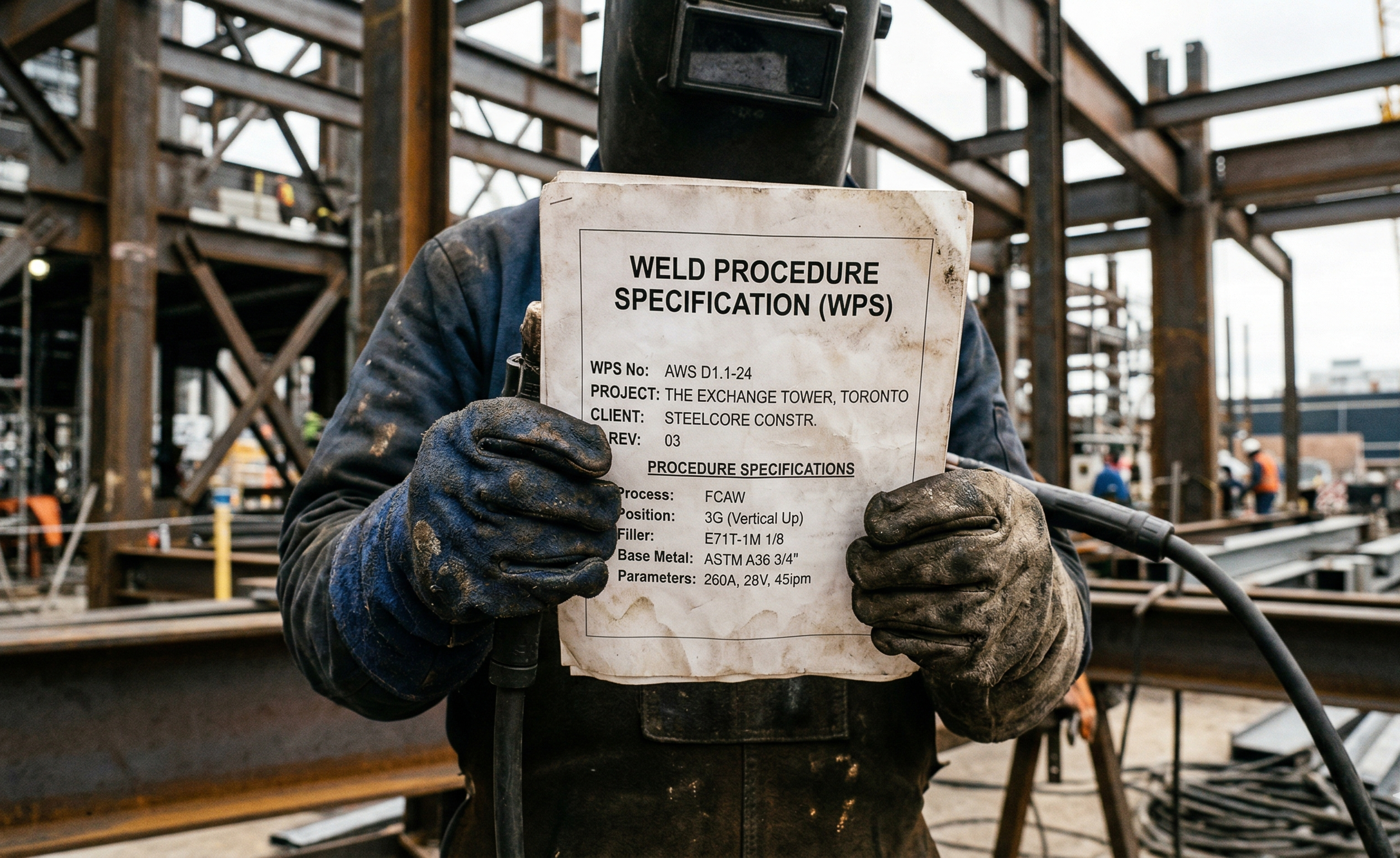
A Weld Procedure Specification is a written document that defines exactly how a specific weld must be made. It is not a general guide to welding. It is a precise technical document that locks down the variables for a particular joint type, material, and application.
A Complete WPS Specifies:
- Base metal type and grade (for example, CSA G40.21 350W structural steel)
- Filler metal classification and diameter
- Welding process (MIG, TIG, Stick, Flux-Core)
- Joint design and geometry (groove angle, root opening, backing)
- Pre-heat and inter-pass temperature requirements
- Welding position (flat, horizontal, vertical, overhead)
- Travel speed, voltage, and amperage ranges
- Post-weld treatment if required
Every one of those variables affects the mechanical properties of the finished weld. Change one without authorization and you may have a weld that looks fine but does not meet the strength requirements the engineer designed to.
What a PQR Is and Why You Need Both
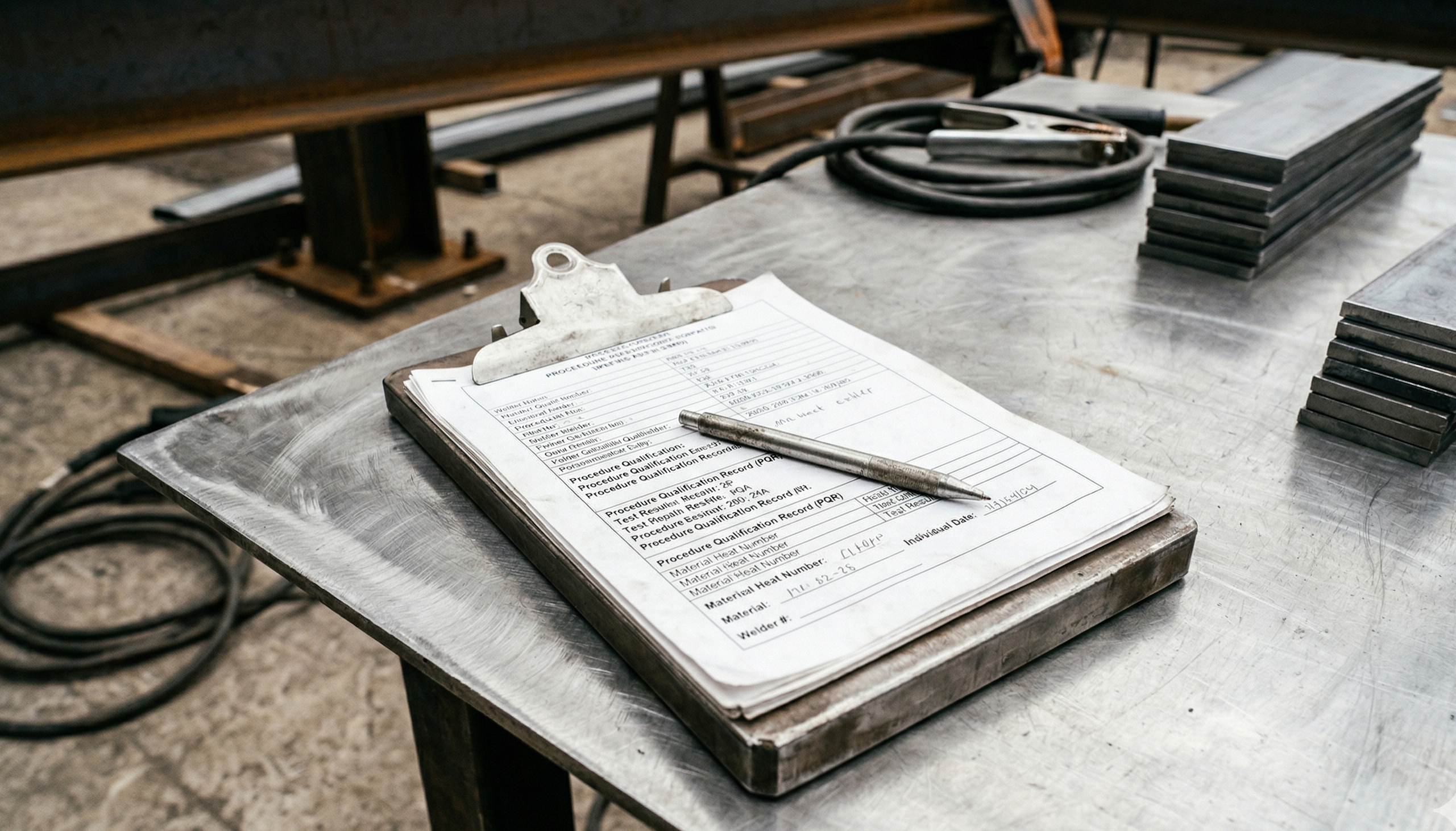
A WPS does not stand alone. It must be backed by a Procedure Qualification Record (PQR).
The PQR is the test record that proves the procedure works. To create a valid PQR, a welder runs the procedure under controlled conditions, the resulting welds are tested mechanically and often non-destructively, and the results are documented. If the test welds pass, the procedure is qualified and the WPS becomes valid.
When Is a WPS Required in Ontario?
Under CSA W59, a weld procedure specification is required for all structural welding. That covers any weld that forms part of a load-bearing connection or is included in a structural assembly governed by the Ontario Building Code.
In practice, that means you need a qualified WPS on file before work begins for:
- Column base plates and anchor bolt connections
- Beam-to-column moment connections and shear tabs
- Splice plates and field splices in structural members
- Welded connections in steel stud bearing wall systems
- Custom fabricated structural components (stairs, lintels, headers, ledger angles)
- Any weld specified on a structural engineer's drawing
If a welding sub tells you a WPS is only for shop work and not required for field welds, that is incorrect. CSA W59 applies to both shop fabrication and field erection. This is equally true for on-site welding performed during steel erection on active construction sites.
What Prequalified Procedures Are and Where They Fit
CSA W59 includes a set of prequalified joint designs. A welding contractor who follows a prequalified joint within the defined limits does not need to run a full PQR test for that joint. The standard itself serves as the qualification basis.
This is legitimate and common for straightforward structural connections using common base metals and standard joint geometries. But prequalified status has strict limits. The moment any variable falls outside the standard's defined ranges, full procedure qualification is required.
If a sub says their procedure is prequalified, ask them to show you the specific clause in CSA W59 that covers it and confirm that all their variables fall within the prequalified limits. That is a reasonable request and a qualified contractor will have the answer.
Who Is Responsible for Having the WPS on Site?
The welding contractor is responsible for producing and maintaining qualified WPS and PQR documentation. As the general contractor, your responsibility is to verify that documentation exists before structural steel welding starts and to ensure it is accessible on site during work.
If a building inspection or structural audit is triggered and your welding sub cannot produce qualified procedure documentation, you are exposed as the GC of record. The liability does not stay with the sub.
What to Do When a WPS Does Not Match the Drawings
This is more common than most GCs realize. A welding sub shows up with a qualified WPS for a standard fillet weld, but the structural drawings specify a partial penetration groove weld on the same joint. Those are different procedures. The existing WPS does not cover the work.
- Stop the welding work on that connection.
- Notify the structural engineer of record.
- Request that the welding sub produce a qualified procedure for the specified joint or obtain an engineer's authorization to use an alternate joint design.
- Do not allow the work to proceed on the assumption that the existing WPS is "close enough."
Structural connections designed as partial penetration groove welds have specific strength assumptions. Substituting a fillet weld without engineering sign-off is a structural change, not a site-level judgment call. If a procedure gap is discovered on an active site, our emergency welding service can mobilize same-day with qualified procedures already in hand.
The Bottom Line for GCs
A Weld Procedure Specification is not paperwork for its own sake. It is the documented proof that a welding procedure has been qualified to produce welds that meet the mechanical and code requirements your structure depends on.
Require it before work starts. Confirm it covers the joints on your drawings. Keep it in your project file. If something goes wrong with a structural weld and there is no qualified procedure on record, that becomes your problem as much as the sub's.

Need Qualified WPS Documentation for Your Project?
CanaWelding Inc. is a division of Canadian Structures — CanaStruct Inc., which holds an HCRA (Home Construction Regulatory Authority) license. Our welders carry qualified WPS documentation for every structural procedure we execute. We provide full submittals before work starts.
Serving Toronto, Mississauga, Brampton, Vaughan, Markham, and the entire GTA.
Call (647) 641-0550 Email Weld@Canawelding.caHCRA-licensed structural contractor · About CanaWelding · Request a Quote
Frequently Asked Questions
What is a Weld Procedure Specification (WPS)?
A WPS is a written technical document that defines exactly how a specific weld must be made. It specifies the base metal, filler metal, welding process, joint design, preheat requirements, welding position, and electrical parameters. Under CSA W59 in Ontario, a WPS is required for all structural welding and must be supported by a Procedure Qualification Record (PQR).
What is the difference between a WPS and a PQR?
A WPS defines how a weld must be executed. A PQR (Procedure Qualification Record) is the test record that proves the procedure works — it documents the results of welding test specimens under controlled conditions. A WPS is not valid without a supporting PQR.
Is a WPS required for field welding in Ontario?
Yes. CSA W59 applies to both shop fabrication and field erection. Any structural weld on an Ontario construction project — whether performed in a fabrication shop or on the job site — requires a qualified Weld Procedure Specification.
Who is responsible for providing the WPS on a construction project?
The welding subcontractor is responsible for producing and maintaining qualified WPS and PQR documentation. The general contractor is responsible for verifying that documentation exists before structural welding starts and keeping copies in the project file.